Air Purifiers & Water Filters — Buy for the Contaminant, Not the Brochure.
The same method works for both categories: name the contaminant, measure or infer it honestly, buy the certified spec that removes it, and ignore every wellness claim left on the box.
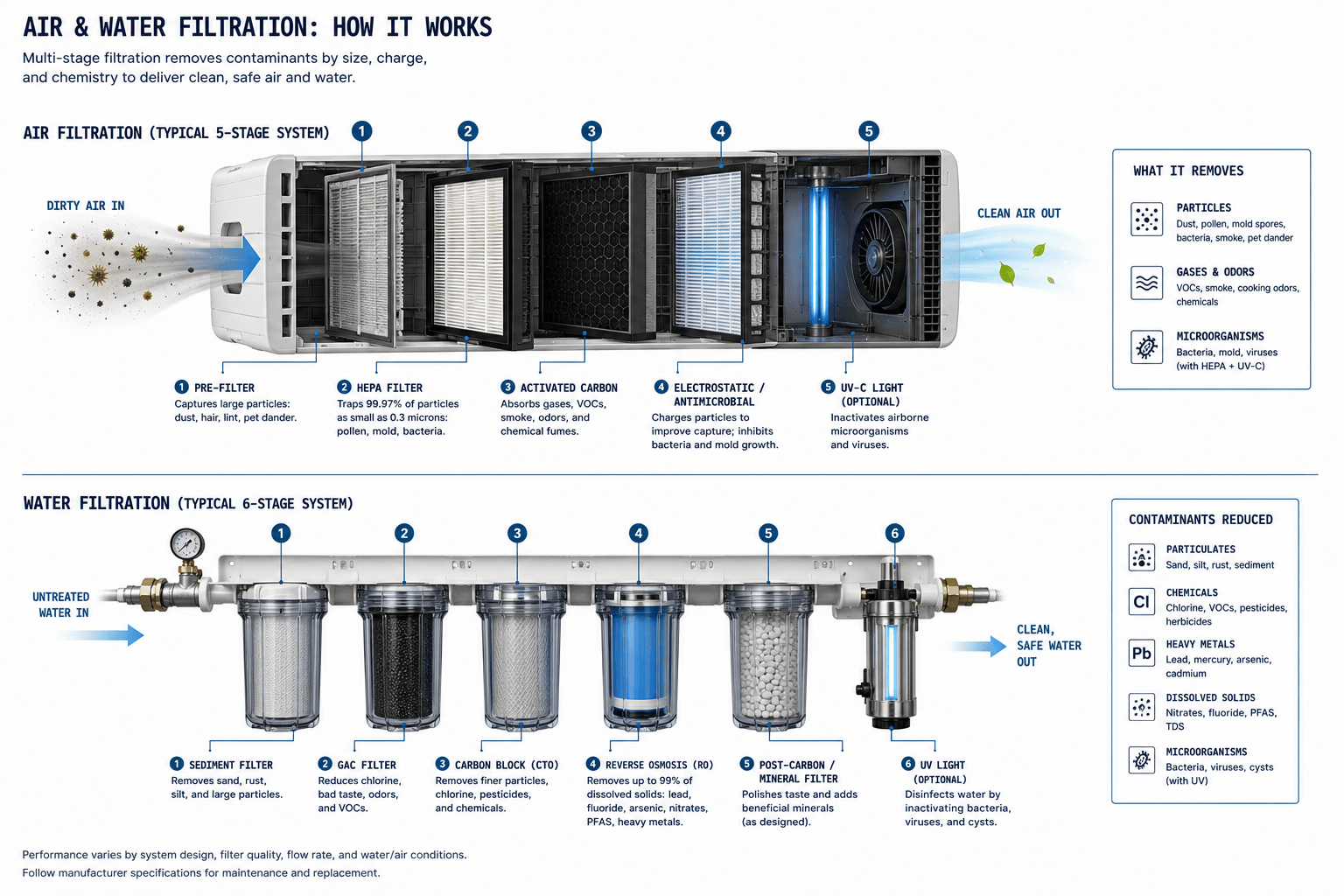
Quick Reference: What's Your Air Problem?
Air purifiers are room machines. They work best on particles when sized by CADR, run continuously, and paired with source control and clean-air ventilation.
| Problem | What Actually Helps | Spec to Look For | Gotcha |
|---|---|---|---|
| Wildfire smoke / PM2.5 | Portable HEPA purifier or CR box in the room you occupy; seal obvious leaks; run before smoke peaks. | smoke CADR enough for 4-5 ACH; MERV 13+ for DIY boxes. | Smoke is particles plus gases. Carbon helps odors, but CADR is only a particle rating. |
| Allergens / pollen | HEPA/CADR in bedroom, vacuum with sealed HEPA, keep windows closed during high pollen. | CADR sized to bedroom; quiet enough for sleep. | A purifier cannot fix bedding, carpets, pets on pillows, or outdoor-air intrusion by itself. |
| Dust | Source control first: clean return grilles, seal filter slot, use HVAC filter your system can handle. | MERV 8-13 HVAC filter; portable unit if one room matters. | Visible dust includes lint and skin flakes that settle before a purifier can capture them. |
| Pet dander | Bedroom unit plus laundry/vacuuming. Use purifier where the person sleeps, not where the pet prefers. | Smoke/dust CADR; replacement filters priced for heavy loading. | Pet allergens stick to fabrics. Air cleaning helps, but upholstery is the reservoir. |
| Odors / VOCs | Remove source, ventilate with clean outdoor air, then use a unit with substantial activated carbon. | Carbon mass and replacement schedule, not CADR alone. | EPA notes there is no widely used CADR-like rating for gas removal. |
| Mold worry | Fix water intrusion, humidity, and contaminated material. Use filtration only as a temporary particle reducer. | Humidity 30-50%; HEPA during cleanup. | EPA is explicit: purifiers do not solve mold growth. Moisture does. |
| Virus season | Ventilation, filtration, and occupancy control. Use purifier as clean-air delivery, not as a shield. | CADR/ACH for the room; CO2 monitor for ventilation behavior. | One small unit in a crowded living room is symbolic if it only delivers 1 ACH. |
| Cooking particles | Use the range hood every time, preferably vented outdoors; backstop with purifier nearby. | Hood capture and outdoor venting; smoke CADR for nearby room unit. | Frying and gas cooking can dominate indoor PM. A purifier after the fact is second-best. |
| Stuffy rooms / headaches | Measure CO2 as a ventilation proxy; open windows or increase mechanical ventilation when outdoor air is clean. | NDIR CO2 monitor; target behavior, not a magic purifier. | HEPA removes particles, not exhaled CO2. A low-particle room can still be under-ventilated. |
| General wellness | Save your money until you can name a pollutant, source, room, and runtime. | No purchase. | "Better vibes" is not a spec. Use the cash on source control or testing. |
The Only Three Air Numbers That Matter
CADR is clean air delivery rate in cubic feet per minute. ACH is air changes per hour. Filter cost is the part the box price hides.
Worked example
A 300 sq ft bedroom with an 8 ft ceiling has 2,400 cubic feet of air. For 5 ACH: 2,400 x 5 / 60 = 200 CFM CADR. EPA's 8-ft table gives the same order: 300 sq ft needs about 195 CADR.
Noise rule: buy enough CADR that the unit works on the speed you will actually tolerate. Many boxes advertise high-speed CADR and low-speed noise separately.
| Number | Definition | Example | When Not to Overpay |
|---|---|---|---|
| CADR | Clean cubic feet per minute for smoke, dust, or pollen particles, normally measured at high speed. | EPA's consumer guide lists 195 CFM minimum for a 300 sq ft room with an 8 ft ceiling. | Do not compare CADR to VOC/odor claims; CADR is a particle rating. |
| ACH | How many room volumes of clean air the purifier supplies per hour: CADR x 60 / room volume. | 200 CADR in 2,400 cubic feet gives 5 ACH. | Do not use floor area alone for lofts, open plans, or 12-ft ceilings. |
| MERV | HVAC filter efficiency rating. EPA suggests MERV 13 or the highest your system can handle for fine particles. | A MERV 13 filter in a compatible furnace slot can reduce PM2.5 while the fan runs. | Do not choke an old blower with a restrictive 1-in filter. Ask HVAC help if airflow drops. |
| Noise at speed | The decibel level on the setting that delivers useful CADR in your room. | EPA gives 50 dB as roughly the noise of a modern refrigerator for context. | Do not buy a tiny quiet unit for a large room; quiet plus under-sized equals decorative. |
| Filter TCO | Total cost of replacement filters over the ownership period. | A $150 unit with $80/year filters costs $550 over 5 years; a $300 unit with $40/year filters costs $500. | Do not treat the shelf price as the real price if the filter is proprietary. |
HEPA Is a Commodity. The CR Box Is the Proof.
Brand premiums can buy quieter fans, better seals, nicer plastics, and sensors. The filter physics are still public: lots of clean air through good media.
About $75-125 in parts, 15 minutes, no magic.
UC Davis WCEC tested four-filter box-fan builds and estimated 165-239 CADR for the lower-cost fan, with 53-61 dB noise at 10 ft and material cost under $75 in 2021. Larger five-filter research builds have reported higher CADR, but fan and filter choice matter.
Wildfire smoke, classroom, garage project, temporary outbreak
Use when raw CADR per dollar matters more than furniture-grade looks. Put it near the occupied zone and let it run.
Ugly, bulky, no auto mode, louder than premium boxes
It is still a taped cube. A bedroom sleeper may prefer a larger commercial unit running on medium/low.
Use ancient fans, touch dirty media, or call it ventilation
Use a newer fan, replace loaded filters, bag dirty filters carefully, and remember that filtration does not add oxygen or remove CO2.
Air Claims That Fail the Physics Test
The useful question is not "does it do something in a lab?" It is "does it deliver enough clean air in an occupied room without making a new pollutant?"
Ozone generators
THEATER / HARM. EPA states no federal agency has approved ozone generators for occupied spaces. Ozone is a lung irritant. Do not use.
Ionizers, plasma, electrostatic add-ons
CHECK OZONE. Some emit ozone. Verify the exact model on CARB's certified-device list and still judge it by CADR.
UV inside small purifiers
USUALLY OVER-SOLD. UV needs dose and dwell time. Air moving quickly past a small lamp is not a room sterilizer.
Essential-oil "purification"
ADDS CHEMISTRY. Fragrance is not filtration. It can add VOCs and irritants while masking the source.
Houseplants as purifiers
NOT ROOM-SCALE. Chamber studies do not translate into meaningful CADR for a house. Enjoy plants for plants.
Smart sensors as the product
NICE, NOT CORE. Sensors and apps can help behavior. They do not replace CADR, seals, runtime, or filter cost.
Air Common Mistakes
Buying one unit for a whole floor
A portable purifier cleans the air that reaches it. Open-plan homes often need multiple units or central filtration.
Running on low in a huge room
Low speed may be one-third of advertised CADR. Use the calculator with the speed you can tolerate.
Never replacing filters
Loaded filters reduce airflow. A washable prefilter is not the same as a renewed HEPA or carbon bed.
Using purifier as mold treatment
Mold is a moisture and material problem. Filtration can reduce spores during cleanup, not cure the building.
Closing the house forever
When outdoor air is clean, ventilation removes CO2 and gases. Use AQI and CO2 to decide, not habit.
Paying for wellness language
"Medical grade," "plasma," and "molecular" claims are secondary. Ask for CADR, carbon mass, and ozone data.
Quick Reference: What's Your Water Problem?
Your utility's Consumer Confidence Report is free and legally required for U.S. community water systems. Read it before spending a dollar.
| Problem | Test First | Filter Class to Match | When Not to Buy |
|---|---|---|---|
| Municipal chlorine taste | Read CCR for disinfectant and disinfection byproducts; taste is often obvious without a lab. | NSF/ANSI 42 carbon pitcher, faucet, fridge, or under-sink filter. | Reverse osmosis is usually overkill for taste alone. |
| Lead risk | First-draw lead test at your tap, especially pre-1986 plumbing or unknown service line. | NSF/ANSI 53 lead point-of-use filter for drinking/cooking water. | A clean utility CCR does not prove your own premise plumbing is lead-free. |
| PFAS headline worry | CCR plus state/utility PFAS data; targeted lab test if local risk or private well. | Certified PFOA/PFOS claim under NSF/ANSI 53 or RO under NSF/ANSI 58; verify listing. | Do not buy a generic carbon filter unless the listing names the PFAS claim. |
| Hard water scale | Hardness test in grains per gallon or mg/L as CaCO3. | Softener or scale-control system; not a safety filter. | Hardness is mostly appliance/soap economics, not a health emergency. |
| Private well | Annual bacteria/nitrate basics plus local risks: arsenic, uranium, PFAS, pesticides, hardness. | Depends on result: UV for microbes, RO for nitrate/arsenic, carbon for VOC/PFAS claims. | Whole-house carbon before testing can hide taste while leaving the real hazard. |
| "Just want it safe" | Municipal: CCR. Well: lab panel. Lead risk: first-draw lead at tap. | Buy only against a named contaminant. | Fear-based bundles create maintenance debt and false confidence. |
| Boil-water advisory | Follow local order; test only after official clearance if instructed. | Boiling, bottled water, or certified microbiological purifier as emergency measure. | Typical carbon filters do not make unsafe microbiological water safe. |
| Refrigerator filter replacement | Check model listing and cartridge date. | NSF listing for chlorine, lead, cysts, or PFOA/PFOS as needed. | Aftermarket cartridges can fit physically without carrying the same certifications. |
The Logo Is Not the Claim
NSF says manufacturers choose which contaminants to certify against. You need the standard number and the contaminant claim, then the current listing for the exact model.
Find the CCR or lab result
Municipal users start at EPA's CCR lookup or the utility site. Private-well users need independent lab testing because federal public-water rules do not monitor your well.
Name the contaminant
"Bad water" is not purchasable. Chlorine, lead, arsenic, nitrate, PFAS, bacteria, hardness, and TDS are different problems.
Search the listing
Use NSF, WQA, IAPMO, or another accredited certifier listing. Confirm the exact model and replacement cartridge, not just the brand.
| Standard / Protocol | Plain-English Meaning | Concrete Use | Gotcha |
|---|---|---|---|
| NSF/ANSI 42 | Aesthetic effects such as chlorine taste, odor, and particulates. | Carbon pitcher for municipal chlorine taste. | 42 does not imply lead, arsenic, nitrate, or PFAS reduction. |
| NSF/ANSI 53 | Health-effects claims for specific contaminants, such as lead, cysts, VOCs, and some PFAS claims. | Lead-certified faucet or under-sink filter for a pre-1986 home. | Certification is per contaminant. Look for "lead" or "PFOA/PFOS" in the listing. |
| NSF/ANSI 58 | Reverse osmosis systems and their reduction claims. | RO for nitrate, arsenic, fluoride, PFAS breadth, or high-salinity cases when certified. | RO is slower, wastes water, and needs cartridges/membranes. It is not the default taste upgrade. |
| NSF/ANSI 401 | Emerging or incidental contaminants such as some pharmaceuticals and pesticides. | Targeted polishing when a tested or local concern exists. | "Emerging" sounds dramatic; it does not mean your water has the contaminant. |
| NSF/ANSI 55 | Ultraviolet microbiological treatment systems. | Private well with bacterial risk after proper prefiltration and flow sizing. | UV needs clear water, power, lamp maintenance, and correct flow. It does not remove chemicals. |
| NSF P231 / P248 / microbiological protocols | Microbiological purifiers for specific emergency or military-style claims. | Travel/emergency treatment where pathogens are the named risk. | Do not assume a camping filter removes dissolved chemicals, PFAS, or salt. |
Filter Formats: Right Tool, Wrong Tool
The housing format is not the technology. A pitcher, faucet mount, fridge cartridge, and under-sink unit can all be carbon. The listing tells you what it actually removes.
| Format | Usually Removes | Typical 2026 Cost Shape | Right Answer When | Overkill / Wrong When |
|---|---|---|---|---|
| Pitcher / dispenser | Chlorine taste; some models certified for lead/PFAS. | $25-60 body, $40-120/year cartridges. | Apartment, low flow needs, chlorine taste, small household. | You need high flow or microbiological safety. |
| Faucet mount | Chlorine, lead/cysts/PFAS if specifically certified. | $30-80 body, $50-150/year cartridges. | Renter wants point-of-use lead or taste reduction without plumbing. | Pull-out faucets, high-volume cooking, or whole-house expectations. |
| Under-sink carbon | Chlorine, VOCs, lead, cysts, PFAS claims depending on cartridge. | $100-500 installed DIY/pro, $60-200/year cartridges. | Permanent kitchen solution with better flow and larger media. | Nitrate, arsenic, salt, or hardness are the named problem. |
| Reverse osmosis | Dissolved ions and many chemicals: arsenic, nitrate, fluoride, PFAS, salts, metals, depending on certification. | $200-900 installed, filters plus membrane; wastewater commonly several gallons per gallon product unless efficient design. | Lab result names nitrate, arsenic, high TDS, fluoride preference, or PFAS breadth. | Your issue is only chlorine taste. Carbon is cheaper and faster. |
| Refrigerator cartridge | Chlorine/taste; some lead/cyst/PFAS claims. | $40-80 per cartridge, often every 6 months. | You already drink from the fridge and the exact cartridge listing matches your need. | Aftermarket lookalike lacks the same certification. |
| Whole-house carbon | Chlorine/chloramine, taste/odor, some VOCs depending on bed size and flow. | $600-3,000+ installed, media replacement varies. | You want chlorine removed from showers/laundry or have whole-house VOC taste/odor issue. | Lead at the kitchen tap. Point-of-use is the precision tool. |
| Softener | Hardness minerals through ion exchange. | $700-2,500+ installed, salt and maintenance ongoing. | Scale, soap scum, appliance life, very hard water. | You are trying to remove lead, PFAS, bacteria, chlorine, or "toxins." |
| UV system | Microbes when water is clear and flow is sized correctly. | $300-1,200+ installed, annual lamp/sleeve service. | Private well has bacterial risk after sediment prefiltration. | Chemicals, PFAS, lead, nitrate, hardness, or taste are the problem. |
Reverse osmosis is powerful and annoying
RO is often the correct answer for specific dissolved contaminants, including nitrate, arsenic, fluoride preference, some PFAS needs, and high-salinity wells. It is also slower, wastes water, uses a storage tank, and adds membrane maintenance. Remineralization is mostly a taste choice unless a specific medical/dietary circumstance exists.
Soft water is not "purified" water
Softeners swap hardness minerals for sodium or potassium ions. That helps scale and soap performance. It does not make unsafe water safe, and softened water may not be ideal as the only drinking source for people limiting sodium.
The TDS Meter Trick and Other Filter Folklore
A good demo can still be a bad measurement. Ask what the device measures, what health threshold applies, and whether a certified treatment claim exists.
TDS meter scare demos
THEATER. TDS estimates dissolved minerals by conductivity. Mineral-rich safe water can read "worse" than distilled water. EPA's 500 mg/L TDS level is a secondary taste/appearance guideline, not a universal poison threshold.
Alkaline ionizer water
THEATER. For ordinary hydration, changing water pH is not a detox strategy. Your stomach is acidic by design. Buy for contaminants, not pH mystique.
Structured / hexagonal / memory water
THEATER. No practical NSF-style contaminant reduction claim. It is narrative packaging around water, not treatment.
Hydrogen water
NOT FILTRATION. Even if studied as a supplement claim, it does not remove lead, PFAS, nitrate, microbes, or chlorine taste.
Bottled water as default
USE CASE, NOT DEFAULT. Legitimate for boil advisories, travel, and some wells. It is not automatically cleaner than good municipal water plus the right point-of-use filter.
Distillers
REAL BUT SLOW. Distillation removes many dissolved substances and is useful for CPAP-style niche needs, but it is energy-heavy and not convenient household flow.
Water Common Mistakes
Buying RO for chlorine taste
A certified carbon filter is usually the cheaper, faster answer. RO is for named dissolved contaminants.
Trusting a logo without the listing
A product can be certified to NSF/ANSI 42 while the box copy implies health protection. Search the exact claim.
Never replacing cartridges
A saturated cartridge can lose performance, clog, or become a growth surface. Calendar the replacement when you install it.
Testing nothing and buying everything
A $30-150 targeted lab test can prevent a $1,000 system that solves the wrong problem.
Whole-house filter for tap lead
Lead often comes from premise plumbing. Treat drinking/cooking water at the tap unless a pro designs a verified whole-house solution.
Panic-buying after a headline
Headlines name a class of risk. Your purchase should name your water source, your test result, and the certified claim.
Verification Notes
Facts below were checked on 2026-07-05. PFAS regulation is the volatile section: EPA posted proposed 2026 changes affecting compliance timing and several PFAS beyond PFOA/PFOS.
- EPA Guide to Air Cleaners in the Home: CADR sizing table, PM2.5, MERV 13, ozone warning, mold caveat, noise context, and filter replacement.
- California Air Resources Board certified air-cleaning devices list: model-level ozone-device check.
- UC Davis WCEC DIY portable air cleaner case study: four-filter CR-box cost, CADR estimate, noise, and limitations.
- EPA Consumer Confidence Reports: CCR lookup and U.S. public-water report workflow.
- EPA PFAS National Primary Drinking Water Regulation page: 2024 MCLs, 2027 monitoring, 2029 compliance in final rule, and May 18, 2026 proposed changes.
- EPA lead in drinking water: tap-level lead risk and plumbing/service-line context.
- NSF home water treatment guidance and NSF contaminant reduction claims guide: certification by standard and contaminant, plus listing verification.
- EPA drinking-water regulations and contaminants: primary standards versus secondary aesthetic guidelines, including 500 mg/L TDS.
Nearby Cheatsheets
Home Maintenance Guide
HVAC filters, water heaters, humidity, seasonal service, and the maintenance cadence around filtration.
Water chemistryHot Tub Treatment
A separate applied water-chemistry sheet for sanitation, pH, alkalinity, and troubleshooting.
Consumer defensePrivacy Data Broker Opt-Out
Another test-first, claim-checking workflow for a marketing-heavy consumer problem.