FLAT
Stackable bus
A thin spacecraft uses fairing volume efficiently: Falcon 9 can carry a dense, dispenser-free stack. The stack is clamped during ascent, then released so each vehicle separates before deploying its array.
A mission-control reference for the spacecraft—not the customer dish. Published numbers are separated from company design targets, derived figures, and engineering details SpaceX has not disclosed.
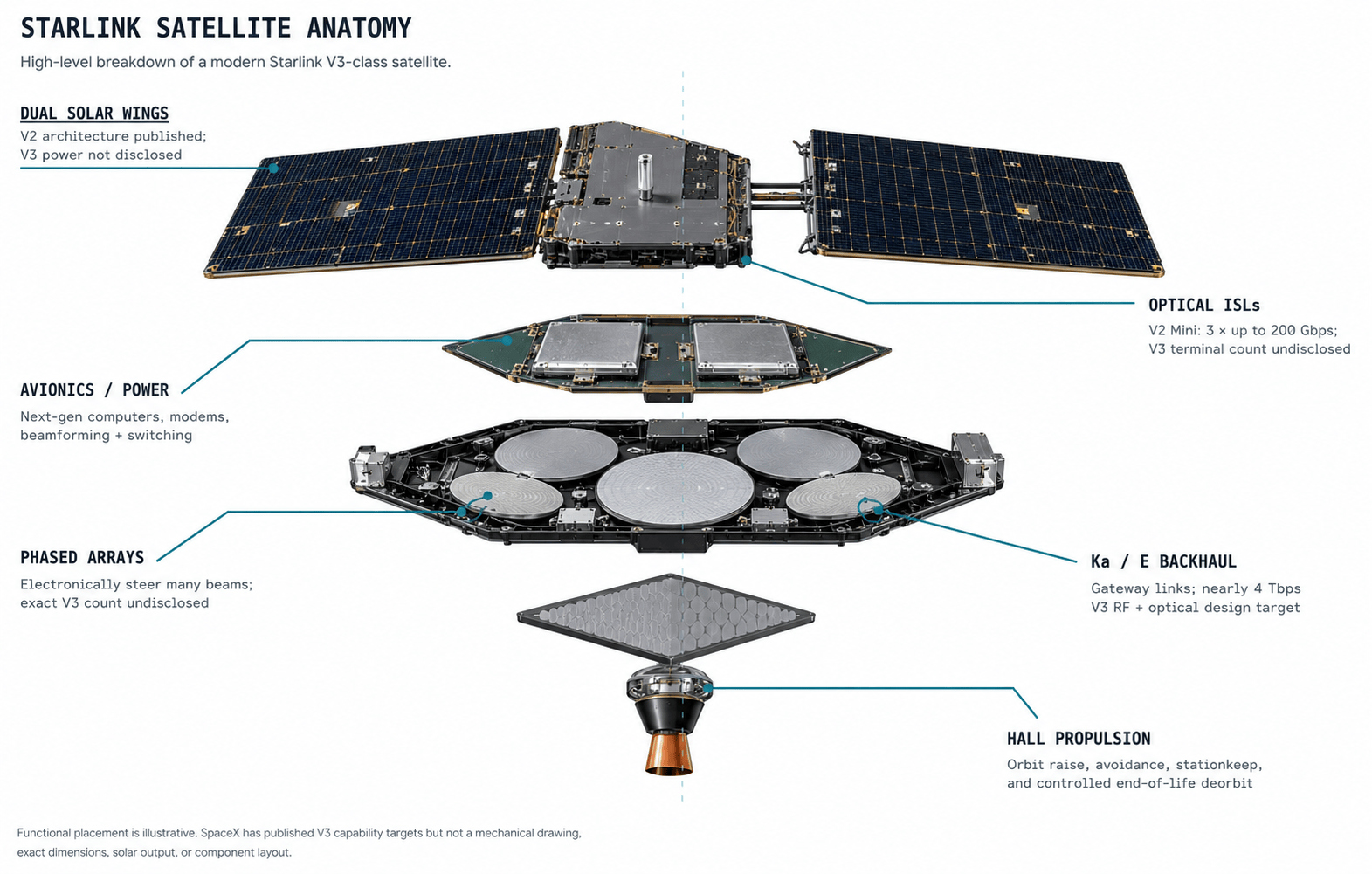
Functional placement is illustrative. SpaceX has published V3 capability targets but not a mechanical drawing, exact dimensions, solar output, or component layout.
The cells are deliberately conservative. “Not disclosed” is more useful than false precision; orange values are announced targets or carefully labeled near-primary reporting, not measured flight performance.
| Specification | V1.0 | V1.5 | V2 Mini | V2 Mini Optimized | V3 broadband |
|---|---|---|---|---|---|
| First launch | Nov 2019 | Sep 2021 | 27 Feb 2023 | Jan 2025 | 28 Sep 2026 · Starship Flight 14 |
| Status · Oct 2026 | Legacy; many retired | Legacy fleet active | Active Gen2 | Current production / majority | First 26 in orbit; on-orbit checkout |
| Launch mass | ≈260 kg (573 lb), archived SpaceX kit | Not published by SpaceX | ≈800 kg (1,764 lb), launch reporting | ≈575 kg (1,267 lb) | Not disclosed* |
| Stowed / deployed dimensions | Not disclosed | Not disclosed | Not disclosed | Not disclosed | Not disclosed* |
| Solar configuration | Single wing | Single wing | Dual aero-neutral wings | Dual wings; power system upgraded | Not disclosed |
| Solar area / electrical power | Not disclosed | Not disclosed | Not disclosed | Not disclosed | Not disclosed* |
| Downlink capacity / satellite | Not separately published | 24 Gbps | 96 Gbps | 96 Gbps class | 1,024 Gbps design target |
| Uplink capacity / satellite | Not disclosed | Not disclosed | Not directly published; V3 stated as >24× | Not directly published | Over 200 Gbps design target |
| RF + optical backhaul | Not disclosed | Not disclosed | Not disclosed | Hundreds of Gbps via optical links | Nearly 4 Tbps combined target (2024) |
| Laser ISLs | No fleet-wide mesh | Laser-equipped; per-sat count not separately published | 3 × up to 200 Gbps | 3 × up to 200 Gbps | Count / rate not disclosed |
| RF payload | Ku user; Ka gateway | Ku user; Ka gateway | 5 Ku phased arrays + 3 Ka/E dual-band antennas | Doppio dual-band backhaul + upgraded avionics | Next-gen modems, beamforming, switching |
| Propulsion | Krypton Hall effect | Krypton Hall effect | Argon Hall effect · 170 mN | Upgraded argon system | Propellant / thrust not disclosed |
| Specific impulse | SpaceX only publishes relative baseline | Not separately disclosed | 2,500 s in SpaceX 2023 release | Not separately disclosed | Not disclosed |
| Launch vehicle / count | Falcon 9 · 60 | Falcon 9 · typically 52–54 | Falcon 9 · up to 23 | Falcon 9 · up to 29 | Starship · 26 on first flight; up to 60 target |
| Operational altitude | V1 + V2 broadband planned at 450–490 km by end-2026 (shell-specific inclinations) | 330–370 km planned; final shells subject to change | |||
| Service life / disposal | Designed for 5+ years; health-triggered deorbit, targeted open-ocean reentry where controllable, demisability as the final protection layer | ||||
SpaceX has not published V3 dimensions or a confirmed launch mass, even after the first 26 flew on Starship Flight 14 (2026-09-28). What is public: each V3 is designed for about 1 Tbps of downlink (1,024 Gbps target, roughly 10x a V2 Mini), Starship is planned to carry up to 60 per launch, and a July 2026 FCC filing uses a 2,000-2,500 kg, 300-400 m² scenario. If that filing describes V3, it is about 3.5-4.3x the 575 kg V2 Mini Optimized. Treat any V3 length or width figure online as an estimate.
This lineup scales visual area by the square root of published or reported mass, not by unverified spacecraft dimensions. It conveys launch-mass growth only. The dashed V3 silhouette is a 2,000 kg scenario, not a confirmed V3 mass.
A thin spacecraft uses fairing volume efficiently: Falcon 9 can carry a dense, dispenser-free stack. The stack is clamped during ascent, then released so each vehicle separates before deploying its array.
SpaceX lists V2 Mini Optimized at about 575 kg, nearly 22% lighter than the original V2 Mini. The gain buys up to 29 satellites per Falcon 9 instead of 23—six more capacity units per mission.
SpaceX projects up to 60 V3 satellites and roughly 61 Tbps downlink capacity per Starship flight, more than 20× the per-launch capacity of a current Falcon 9 batch. This is a launch-system dependency, not merely a bigger panel.
V2 uses four reaction wheels in a hot-spare architecture. They point the RF beams, align solar arrays, manage low-drag flight attitudes, and preserve control deep into targeted reentry.
“Star Trekker” cameras recognize star fields to estimate attitude. Combined with onboard position and velocity, that state estimate supports beam placement, formation spacing, and autonomous maneuver planning.
SpaceX does not publish a V3 mechanical drawing, exact envelope, dry/wet mass split, processor count, thermal design, battery chemistry, or radiation-hardness figures. Treat detailed internet cutaways as conjecture.
User links and backhaul are different paths. Electronically steered Ku beams serve many moving footprint cells; larger-capacity Ka/E links connect satellites to gateway sites. Optical ISLs move traffic between satellites but do not talk to the customer dish.
| Link / function | Direction | Authorized / published band | Generation notes | Engineering use |
|---|---|---|---|---|
| User downlink | Space → terminal | Ku: 10.7–12.7 GHz | Gen1 + Gen2 | Steered spot beams deliver customer data; terminal plan and congestion still cap user speed. |
| User uplink | Terminal → space | Ku: 14.0–14.5 GHz | Gen1 + Gen2 | Return traffic from electronically steered customer terminals. |
| Gateway downlink | Space → gateway | Ka: 17.8–18.6 & 18.8–19.3 GHz | Gen1 + Gen2 authorizations | Moves aggregated traffic toward terrestrial points of presence. |
| Gateway uplink | Gateway → space | Ka: 27.5–29.1 & 29.5–30.0 GHz | Gen1 + Gen2 authorizations | High-capacity feeder link; rain fade and gateway diversity matter. |
| E-band downlink | Space → gateway | 71.0–76.0 GHz | Gen2 authorized Mar 2024 | Five GHz of high-frequency backhaul spectrum; tighter atmospheric and pointing margins. |
| E-band uplink | Gateway → space | 81.0–86.0 GHz | Gen2 authorized Mar 2024 | Complements Ka with much wider feeder-link bandwidth. |
| Optical ISL | Satellite ↔ satellite | Infrared laser; wavelength not published here | Operational mesh from V1.5 onward | Vacuum crosslink avoids terrestrial fiber detours; requires line-of-sight acquisition and routing. |
| Direct to Cell | Phone ↔ satellite | Partner terrestrial mobile spectrum | Dedicated V1 Mobile payloads, not every broadband V2 | Custom phased arrays and eNodeB/5G-class modem functions make the spacecraft act as a cell tower. |
| TT&C / beacons | Control + tracking | Multiple authorized channels; configuration-specific | All generations | Keep command, telemetry, orbit determination, and emergency operations distinct from customer capacity. |
| Generation | Laser status | Terminals / satellite | Published rate | Operational meaning |
|---|---|---|---|---|
| V1.0 | Early fleet not built around a global optical mesh | Not a fleet-wide standard | N/A / experiments varied | Traffic depended more heavily on a satellite simultaneously seeing a user and gateway. |
| V1.5 | Operational laser crosslinks introduced | Not separately stated in current primary docs | Not separated by generation | Polar/ocean routes could forward traffic toward distant gateways. |
| V2 Mini | Operational | 3 | Up to 200 Gbps each | Three neighbors give routing choices as geometry changes; “up to” is a link ceiling, not assured payload throughput. |
| V2 Mini Optimized | Operational | 3 | Up to 200 Gbps; 400 Gbps operation was a 2026 upgrade target | 2025 jitter rejection and faster route reaction cut ping loss 2–3×, per SpaceX. |
| V3 | Designed into next generation | Not disclosed | Not disclosed | V3’s “nearly 4 Tbps” figure combines RF and optical backhaul; it is not a per-laser specification. |
SpaceX reported more than 24,000 lasers in the constellation in its 2025 report. That is a fleet count, not 24,000 simultaneous end-to-end routes.
Two third-party-bus Mini Laser demonstration units transferred more than 25 Gbps to the existing mesh in summer 2025, proving a smaller hosted-terminal path.
A satellite over an ocean can relay across moving neighbors until one sees a gateway. The scheduler must continuously reacquire links and route around weather, outages, geometry, and congestion.
A Hall thruster ionizes stored gas and accelerates the ions electrostatically. It produces tiny force for long periods: excellent for orbit raising, spacing, conjunction avoidance, stationkeeping, and disposal—useless for launch from Earth.
| Decision criterion | Xenon | Krypton | Argon | Starlink consequence |
|---|---|---|---|---|
| Availability | Rare trace gas; constrained market | More available than xenon, still rare | ≈0.93% of dry atmosphere; industrial bulk gas | Argon aligns propellant supply with mass production of thousands of spacecraft. |
| Storage / particle mass | Heavy atoms ease thrust efficiency but storage is dense/expensive | Middle ground used by V1/V1.5 | Lighter atom requires a purpose-built thruster and different flow/voltage trade | Do not assume a cheaper gas is a drop-in replacement. |
| Procurement economics | Highest commodity-price exposure | Lower than xenon | Orders-of-magnitude supply advantage; SpaceX does not publish its delivered $/kg | Use relative economics, not internet spot-price tables that ignore purity, cylinders, and contracts. |
| Starlink flight use | No production generation identified | V1.0 + V1.5 | V2 Mini + Optimized | V3 propellant remains undisclosed as of 2026-07-14. |
About the weight-force of a 17 g object on Earth. SpaceX reports 2.4× first-generation thrust and 1.5× its specific impulse; its 2023 release listed 2,500 s Isp.
Starlink’s 2026 space-safety documentation says satellites use daily stationkeeping burns to constrain radial offset and along-track spacing. Avoidance burns are additional, conjunction-driven events.
Onboard state and SpaceX’s screening system support autonomous planning. “Autonomous” does not mean uncoordinated: operators exchange ephemerides and SpaceX still applies maneuver policies and health gates.
SpaceX says V2 uses dual solar arrays arranged to improve on-orbit maneuvering and control. In very low orbit, even a deployed solar wing sees enough residual atmosphere for drag attitude to matter.
High-capacity batteries run the bus and payload when Earth blocks the Sun. Charge state, thermal limits, and payload demand must be scheduled across repeated roughly 90-minute LEO orbits; exact capacity is private.
SpaceX has not published a V3 solar-array area, nameplate output, or battery capacity. The often-repeated 10–12 kW range is an enthusiast estimate and is intentionally omitted.
Falcon 9 releases a tensioned flat stack; the satellites drift apart. Starship tests have demonstrated a side-mounted “Pez” slot with simulator satellites, and Flight 14 (2026-09-28) deployed the first 26 production V3 satellites from it.
Vehicles inserted low must pass health checks and begin orbit raising within days. Multiple temporary waypoints keep the transfer flow separated from crewed stations and settled shells.
At the assigned shell, daily burns maintain spacing while RF beams and optical crosslinks continuously hand off. SpaceX’s current broadband shell plan spans 450–490 km; V3 is planned lower.
Health metrics trigger retirement. A controllable satellite lowers itself and targets open ocean; attitude control continues to about 125 km. Demisable parts are the last risk-control layer.
Starlink’s current space-safety documentation says satellites are designed to serve for more than five years. Individual retirement depends on health, capacity economics, shell changes, and conjunction risk.
The 2025 progress report says Starlink targets less than 3 joules at component level, versus the U.S. debris-mitigation reference of 15 J. This is a design-analysis target, not a guarantee every atom vanishes.
SpaceX’s July 2026 public space-safety plan places V3 broadband between 330 and 370 km by end-2026, with detailed shell geometry still subject to change.
CORRECTION // SpaceX identifies next-generation computers, modems, beamforming, and switching, plus an order-of-magnitude capacity jump and lower target orbit. The mechanical details remain private.
CORRECTION // Satellite capacity is shared across beams, gateways, users, routing overhead, spectrum, and time. Terminal capability, service plan, congestion, visibility, and weather constrain an individual session.
CORRECTION // The user terminal uses RF. Lasers connect spacecraft to spacecraft, relaying aggregated traffic until it can reach a satellite with a usable ground path.
CORRECTION // Customer-terminal generations, broadband spacecraft generations, and mobile/DTC spacecraft families are separate product lines with overlapping “V” or “Gen” labels.
CORRECTION // An application describes a requested operating envelope. It can be deferred, modified, partially granted, or never built. SpaceX design targets are not measured orbital performance.
CORRECTION // DTC payloads are mission-specific mobile satellites. SpaceX’s own prospectus distinguishes V1/V2 Mobile from V2 Mini and V3 broadband spacecraft.
Every volatile number on this page is either traceable here, labeled as a company target, or explicitly withheld. Accessed 2026-07-14.