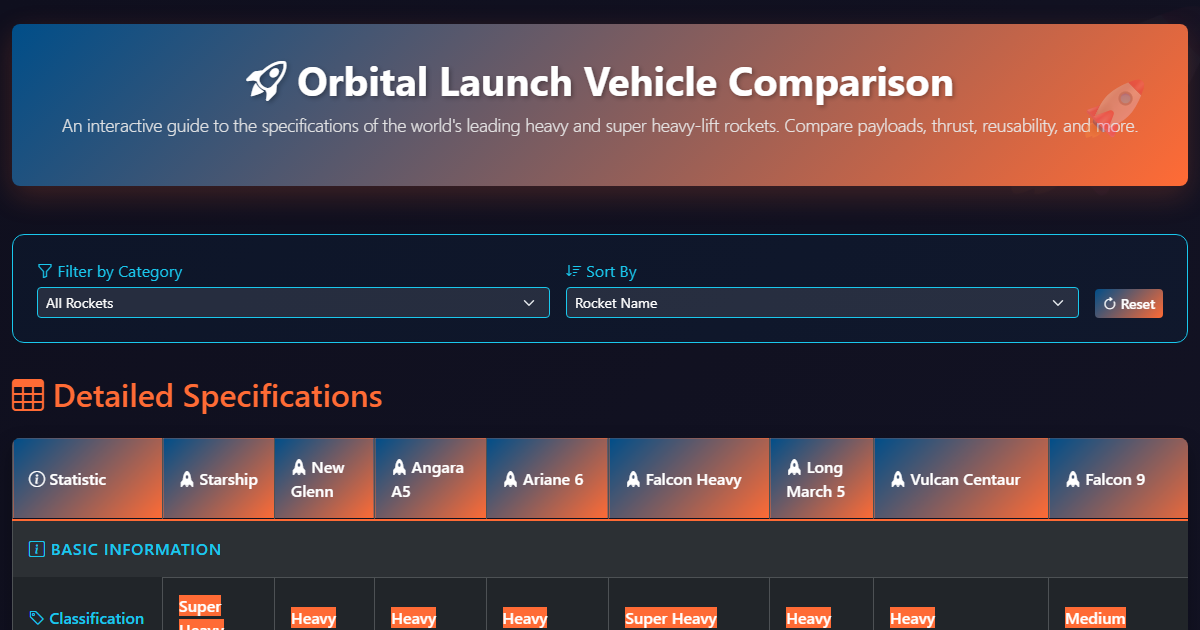
Launch vehiclesPayloadReuse
Orbital Rockets Comparison
The full launch-vehicle reference: payload to LEO/GTO, height, thrust, reuse model, cost, and status — filterable and sortable by lift class.
Open guideOne place to compare the world's launch vehicles by payload, thrust, and reuse — then follow the spaceflight stack from rocket to orbit, satellite, and habitat. Each row links to a deeper cheat sheet.
The active and near-term heavy/medium orbital rockets, ranked by payload to low Earth orbit (LEO). Reuse and status drive real cost and cadence far more than raw payload — a lighter reusable rocket often beats a heavier expendable one on price per kilogram. Figures as of 2026; open the deep-dive for live specs and per-mission caveats.
| Rocket | Maker | LEO payload | Height | Reuse | Status | First flight |
|---|---|---|---|---|---|---|
| Starship | SpaceX | 150,000 kg target | 124 m | Full (target) | Test flights | 2023 |
| Falcon Heavy | SpaceX | 63,800 kg | 70 m | Boosters + fairings | Operational | 2018 |
| New Glenn | Blue Origin | 45,000 kg | 98 m | First stage | In recovery | 2025 |
| Vulcan Centaur | ULA | 27,200 kg | 61.6 m | Expendable | Investigation | 2024 |
| Long March 5 | CASC | 25,000 kg | 57 m | Expendable | Operational | 2016 |
| Angara A5 | Roscosmos | 24,500 kg | 55.4 m | Expendable | Operational | 2014 |
| Falcon 9 | SpaceX | 22,800 kg | 70 m | First stage + fairings | Operational | 2010 |
| Ariane 6 | ArianeGroup / ESA | 21,650 kg | 63 m | Expendable | Operational | 2024 |
Getting mass to orbit is only step one. Each layer below has its own engineering constraints — and its own cheat sheet.
Thrust, staging, reuse economics, and the payload/orbit tradeoff. Rockets →
What a modern satellite carries, and how a LEO constellation stays connected. Starlink →
Closing the loop on air, water, and heat once people stay in space. Habitats →
From supersonic flight in the atmosphere to the life cycle of stars. Stars →
The full deep-dive references behind the comparison above.
The full launch-vehicle reference: payload to LEO/GTO, height, thrust, reuse model, cost, and status — filterable and sortable by lift class.
Open guide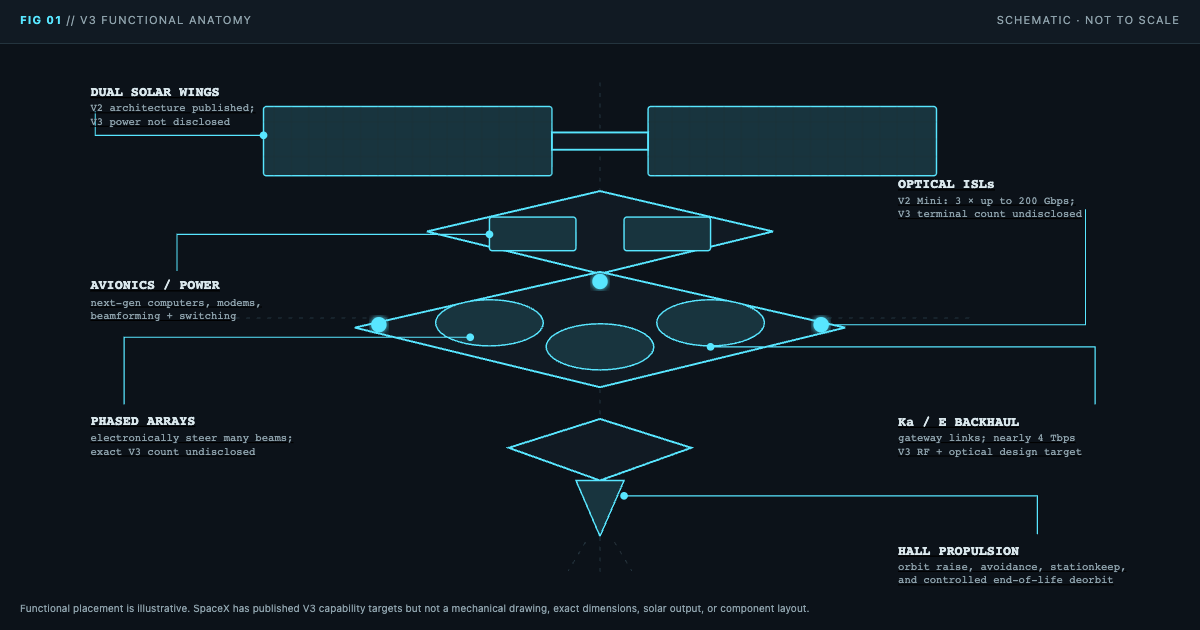
What a modern LEO satellite is made of, V1 to V3: phased-array antennas, ion thrusters, inter-satellite laser links, and mass budgets.
Open guide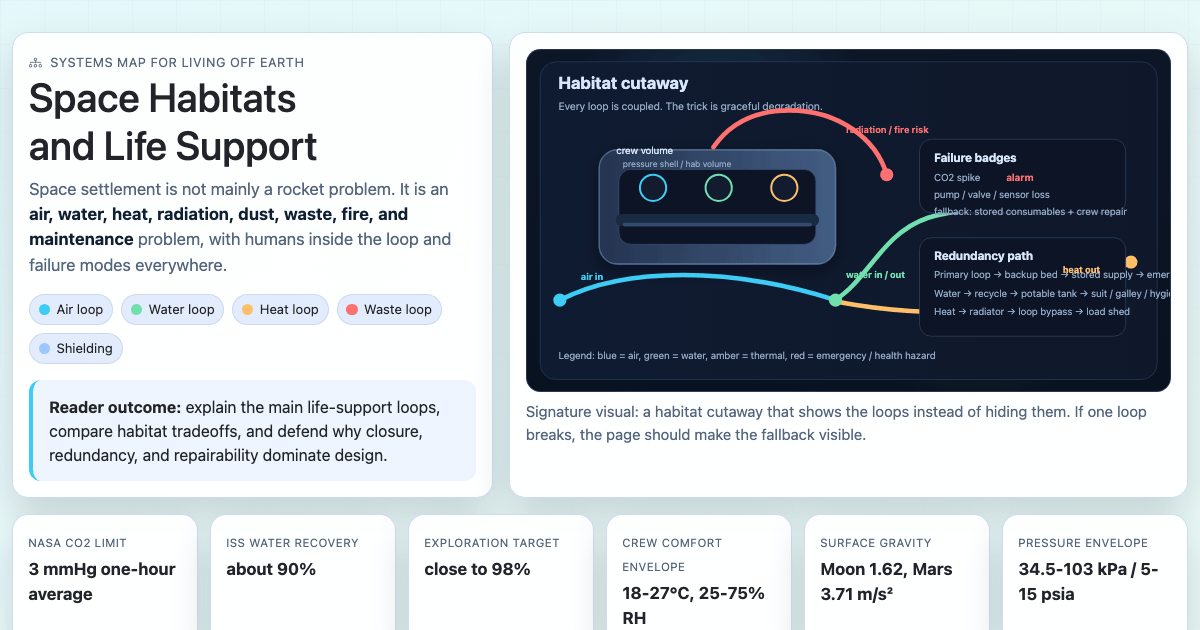
Closed-loop air, water, and thermal control: how you keep humans alive off Earth, and where the recycling loops still leak.
Open guide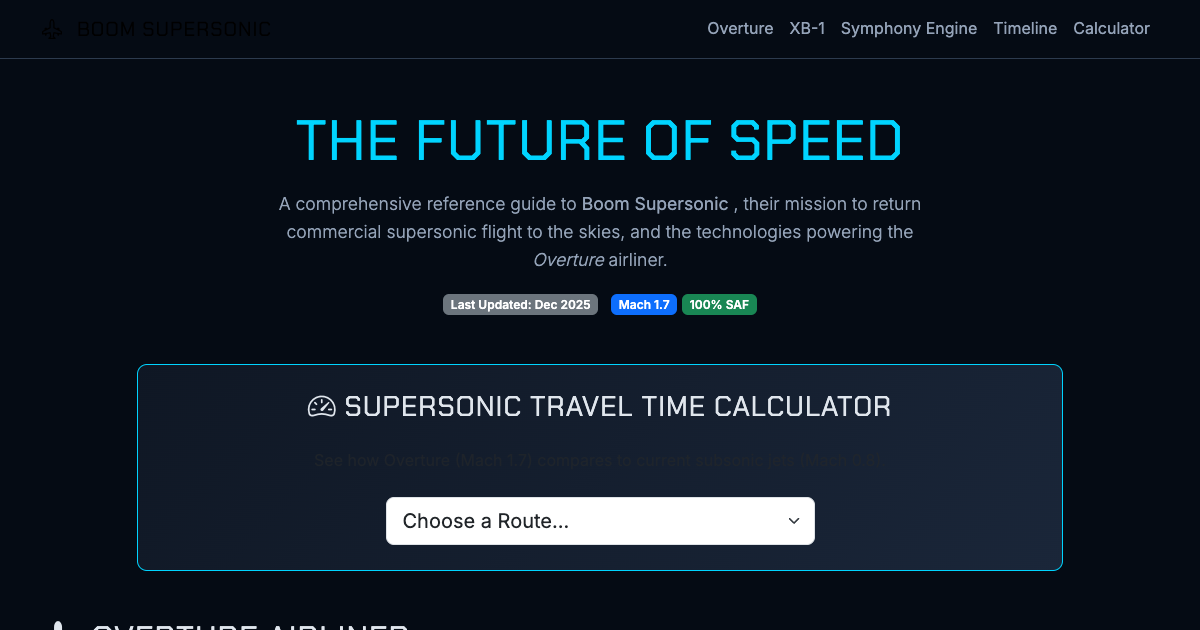
Overture specs, range, speed, and program timeline — the atmospheric-flight companion to the orbital vehicles above.
Open guide
From nebula to supernova and beyond: the birth, main sequence, and death of stars, as a scroll-driven visual journey.
Open guideNot spaceflight, but built by the same companies pushing the same limits — worth a look if rockets are your lens on hard engineering.