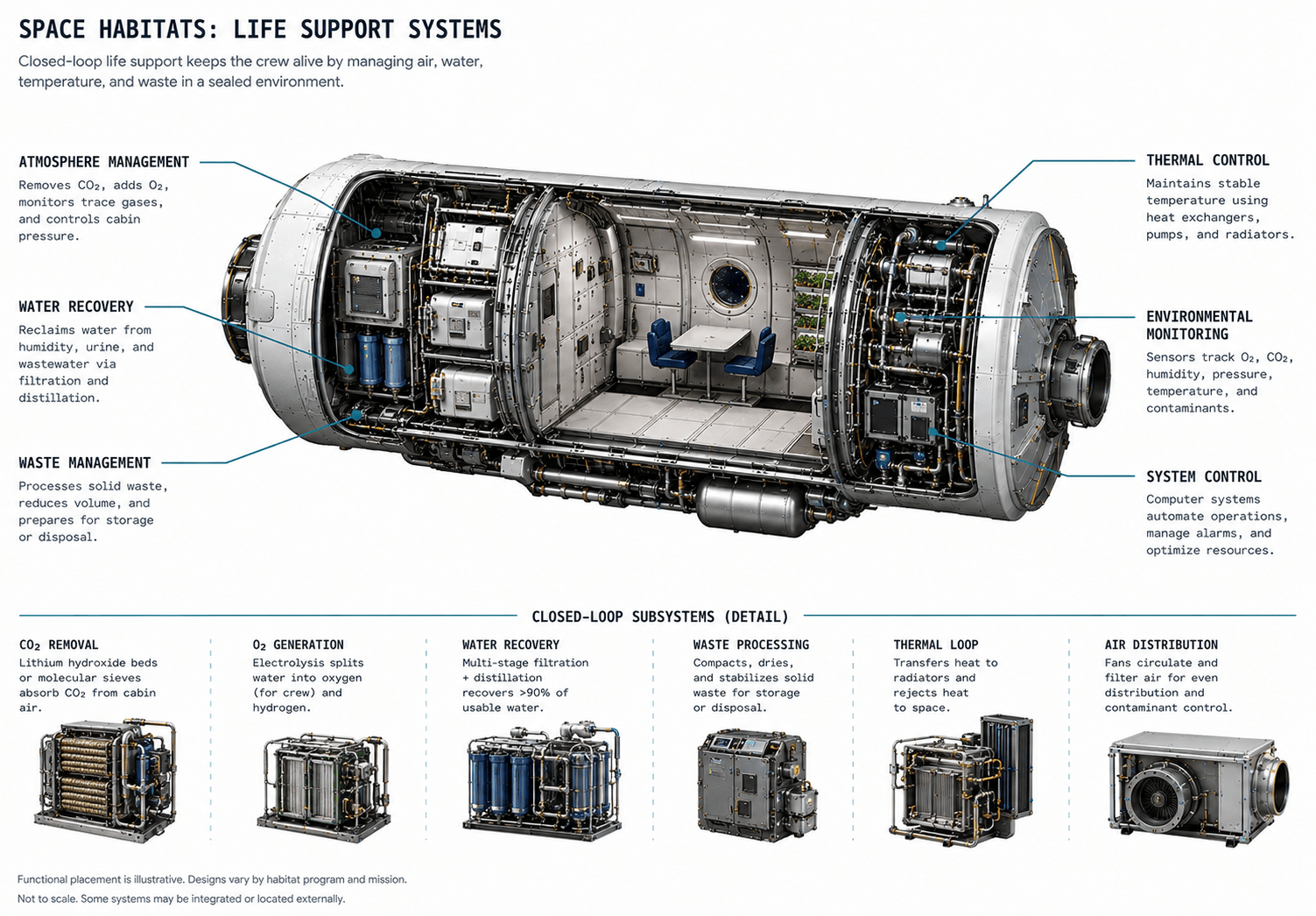
Quick Reference
The shortest useful answer: every subsystem exists to keep one of the human loops inside a narrow operating envelope, while the design buys time when something breaks.
| Subsystem | What it does | Common technology | Failure consequence | Redundancy / fallback |
|---|---|---|---|---|
| Pressure control | Holds cabin pressure inside the human-safe envelope and manages slow depressurization. | Pressure regulators, leak detection, isolation valves, suit interfaces. | Hypoxia, barotrauma, suit-prep problems, forced emergency procedures. | Stored gas, compartment isolation, suit-safe procedures, conservative pressure changes. |
| Oxygen generation | Turns processed water into breathing oxygen. | Electrolysis assemblies, oxygen tanks, hydrogen handling, Sabatier loop. | Slow oxygen depletion if storage is not available. | Stored oxygen, alternate generation path, crew power management. |
| CO2 removal | Removes exhaled carbon dioxide before it accumulates and becomes symptomatic. | Molecular sieves, lithium hydroxide, catalytic beds, trace monitoring. | Headache, fatigue, degraded cognition, then mission-ending atmospheric failure. | Dual beds, trending, spare cartridges, emergency isolation, conservative occupancy. |
| Trace contaminant control | Scrubs volatile organics and other cabin contaminants from electronics, plastics, and crew off-gassing. | Activated charcoal, catalytic oxidizer, LiOH bed, ventilation mixing. | Odor, irritation, long-duration health risk, poorer habitability. | Continuous monitoring, replaceable beds, airflow management. |
| Water recovery | Reclaims humidity condensate, urine, hygiene water, and suit water into potable water. | Urine processor, water processor, multifiltration beds, catalytic oxidizer. | Rapid consumables burn, logistics penalty, limited hygiene and food prep. | Storage tanks, sterilization / polishing, spare filters, external resupply. |
| Thermal control | Moves heat out of the pressure vessel and rejects it to space or a surface radiator. | Liquid loops, radiators, heat exchangers, insulation, fans. | Overheating, equipment derating, power shedding, crew discomfort. | Load management, bypass loops, variable set points, stored thermal margin. |
| Radiation shielding | Reduces exposure to solar particle events and the chronic background from galactic cosmic rays. | Water walls, multifunction structure, regolith cover, storm shelter. | Acute radiation event or cumulative dose growth. | Central safe haven, local shielding, mission timing, operational sheltering. |
| Waste handling | Contains urine, feces, hygiene waste, and trash without contaminating the cabin. | Toilets, collection devices, compaction, bags, disinfecting materials. | Odor, contamination, sanitation burden, lost volume. | Closed containers, cleanable hardware, trash volume planning, serviceable parts. |
| Food support | Provides calories, water, nutrients, and morale; plants may supplement, not magically eliminate logistics. | Packaged food, refrigeration where available, Veggie-style growth, crop studies. | Low variety, morale decline, growing logistics burden. | Resupply, shelf-life planning, fresh-produce supplements, crop experiments. |
| Maintenance | Keeps pumps, valves, filters, software, and sensors working long after launch. | Replaceable racks, spares, diagnostics, crew procedures, trend analysis. | Common-mode failures, blocked filters, stalled pumps, cascading system loss. | Repairability, spare parts, monitoring, conservative utilization, crew time reserved for upkeep. |
Human Requirements
The habitat has to stay inside the envelope that keeps humans conscious, comfortable enough to work, and stable enough to avoid a slow spiral into fatigue and bad decisions.
Atmosphere and pressure
NASA-STD-3001 Volume 2 Revision D keeps crew exposure between 34.5 kPa and 103 kPa for indefinite human exposure and requires oxygen partial pressure to stay within the current table-based envelope.
The standard also says low pressure helps suit transfer, but lower pressure means the atmosphere needs more oxygen, which raises fire risk.
CO2 and ventilation
The current NASA requirement limits average one-hour cabin CO2 to 3 mmHg. NASA also requires continuous recording and real-time display of pressure, humidity, temperature, ppO2, and ppCO2.
That is why the atmosphere loop is both a chemistry problem and a sensor problem.
Temperature and humidity
NASA anchors crew-health limits at 18°C and 75% RH on one corner of the comfort envelope and 27°C and 25% RH on the other. Crew performance is better in the tighter comfort zone, not just the survivable zone.
Set points must be adjustable in small steps, because humans and tasks vary.
Water, sleep, exercise, and medical care
NASA’s ISS ECLSS fact sheet says each astronaut needs about a gallon of water per day for drinking, food prep, and hygiene. Long missions also need sleep protection, exercise, medical monitoring, and privacy.
A habitat that ignores sleep or exercise may be technically pressurized and still fail the crew.
| Requirement | Current target | Why it matters | Design implication |
|---|---|---|---|
| Cabin pressure | 34.5-103 kPa / 5-15 psia for indefinite exposure. | Too low risks hypoxia and barotrauma; too high raises structural mass and suit-interface complexity. | Pressure shell, leak tolerance, and suit ops have to be co-designed. |
| CO2 | 3 mmHg one-hour average in the habitable volume. | CO2 is the simplest way to make a crew feel bad and work badly before the atmosphere looks obviously broken. | Use continuous scrubbing, mixing, and trend alerts, not a one-time capacity guess. |
| Oxygen / diluent gas | NASA requires the current table-based ppO2 envelope and at least 30% diluent gas in the cabin atmosphere. | Oxygen alone is not enough; fire risk and decompression strategy matter. | Keep a stable inert buffer, and never treat oxygen percentage as a stand-alone design knob. |
| Temperature and RH | Comfort envelope anchored at 18°C/75% RH and 27°C/25% RH. | Dry eyes, irritated mucous membranes, microbial growth, and static electricity all show up outside the band. | Provide local set-point control and airflow shaping, not just one global thermostat. |
| Water | About a gallon per astronaut per day for ISS-class operations. | Water is one of the easiest things to underestimate when the crew can no longer call a truck. | Size potable storage, recovery, and hygiene loops together. |
| Human factors | Spaces need data displays, privacy, sleep protection, and exercise accommodation. | The crew is part of the system load, not a bolt-on afterthought. | Reserve crew time, lighting control, acoustic control, and maintenance access early. |
Atmosphere Loop
This is the most unforgiving loop because humans consume it continuously, and cabin chemistry drifts even when the vehicle is parked.
Oxygen generation
The ISS ECLSS uses water electrolysis: water goes in, oxygen is delivered to the cabin, and hydrogen becomes a separate management problem. NASA’s current ISS fact sheet and ECLSS reference both describe this loop.
Example: the system can use water recovered from humidity and urine, so oxygen production depends on the water loop instead of just a tank.
CO2 removal
CO2 is scrubbed with molecular sieves, lithium hydroxide, and catalytic beds. NASA’s current technical brief keeps the average one-hour cabin limit at 3 mmHg, and the older ISS operations story shows why even a few mmHg too much becomes operationally urgent.
Gotcha: a crew can be below the panic threshold and still be below the performance threshold.
Diluent gas and pressure choice
NASA’s current brief says the cabin atmosphere shall contain at least 30% diluent gas assuming balance oxygen. The same standards set a low-pressure floor because low pressure makes EVA suit transfer easier, but oxygen-rich atmospheres feed fires.
Example: NASA-STD-3001 notes that 3.8 psia is the lowest pressure at which normoxia is maintained at 100% O2.
Ventilation, trace contaminants, and fire risk
Ventilation is not optional. NASA requires continuous display and alerting for pressure, humidity, temperature, ppO2, and ppCO2, and the ECLSS air-revitalization path removes contaminants from plastics, electronics, and crew off-gassing.
When not to assume success: a clean-looking cabin with poor mixing can still have local CO2 or thermal pockets.
| Element | Role | Typical hardware | Failure mode | Design response |
|---|---|---|---|---|
| Oxygen generation assembly | Splits water into O2 and H2. | Electrolyzer stack, power conditioning, water feed. | Cabin O2 inventory shrinks unless stored O2 or backup generation covers the gap. | Store oxygen, add redundant feed paths, and keep demand forecasts conservative. |
| Carbon dioxide reduction | Uses hydrogen and crew CO2 to create methane and water in a Sabatier loop. | Sabatier reactor, water management, hydrogen handling. | Hydrogen or reactor issues reduce loop closure and add consumables pressure. | Use stored water and alternate oxygen paths; treat methane as a byproduct, not free fuel. |
| CO2 scrubbers | Remove exhaled CO2 from cabin air. | Molecular sieve beds, LiOH, catalytic oxidizer, fans. | Headaches and degraded cognition appear before people notice the root cause. | Trend limits, bed redundancy, telemetry, and a replacement schedule. |
| Trace contaminant control | Removes volatile organics and odor. | Activated charcoal, oxidizer, replaceable beds. | Long-duration irritation and poor habitability. | Monitor cabin chemistry, maintain airflow, and budget replacement parts. |
| Compartment ventilation | Mixes the atmosphere so no local pocket becomes dangerous. | Ducting, fans, diffusers, local sensors. | Dead zones, hot spots, odor pockets, false confidence from a single sensor. | Place sensors and vents by habitability geometry, not only by duct convenience. |
| Pressure changes and airlocks | Connects cabin atmosphere to EVA and docking operations. | Airlocks, suit ports, pressure controls, isolation valves. | Rapid pressure change can trigger decompression risk. | Use controlled rates; NASA-STD-3001 limits pressure changes above 1 psi to 13.5 psi/min. |
Water and Waste Loop
Water recovery is where the engineering turns from philosophy into plumbing. Every liter not recovered becomes launch mass, storage mass, or a hygiene problem.
| Stream | What NASA does now | Why it matters | Example / gotcha | Closure path |
|---|---|---|---|---|
| Urine | Collected, processed, and distilled into water. | Urine is too valuable to waste on long missions. | NASA’s waste brief gives an average urine-output formula of Vu = 3 + 2.5t liters per crewmember, where t is mission length in days. A 180-day mission implies 453 L of handling per person. | Urine processor, distillation, brine management, water polishing. |
| Humidity condensate | Captured from sweat and breath and sent back through the water processor. | This is one of the cleanest recovery streams. | People breathe and sweat even when the vehicle is parked. | Condensate capture, filtration, conductivity check, potable tank. |
| Hygiene water | Reused where possible and treated as wastewater where not. | Hygiene is part of crew health, not a luxury. | A habitat that saves water by eliminating hygiene usually spends it elsewhere in sanitation or medical risk. | Stream separation, cleaning, and reuse planning. |
| Suit water | Hydration water from EVA systems is included in current ISS recovery paths. | EVA adds another consumable loop outside the cabin. | Ignoring suit water is a common accounting mistake when comparing missions. | Account for suit supply, reclaim, and packaging mass together. |
| Trash and solids | Stored, compacted, or returned; on ISS, many trash items are loaded into a spent resupply vehicle and burn up on reentry. | Volume is usually the first scarce resource, not just mass. | Trash seems harmless until it consumes the volume you needed for spares. | Compaction, segregation, cleanable containers, planned return or recycling. |
| Brine / residues | Leftover concentrated waste remains a hard exploration problem. | Regeneration is not complete if the leftovers still need storage. | The “dirty remainder” is often where the real complexity sits. | Brine processing, drying, compaction, or future conversion tech. |
Current ISS number
NASA says the ISS Water Recovery System can recover and recycle about 90% of the water on station. That is good, but not enough to pretend resupply is optional.
Exploration target
NASA says life-support systems for long journeys ideally recover close to 98% of carried water. That number is a design target, not a magic switch.
Current ISS handling
NASA’s current ECLSS fact sheet says wastewater includes urine, cabin humidity condensate, and EVA suit hydration water. Current systems are already a multi-stream water plant, not a single filter.
Thermal and Power
Heat is the hidden tax of living in a sealed box. If you cannot reject it, you cannot keep living in the box for long.
Internal heat load
Humans, avionics, lights, pumps, and exercise all dump heat into the habitat. NASA’s standards explicitly call out the extra heat, CO2, perspiration droplets, odor, and particulates generated during exercise.
Example: a treadmill room needs air handling and thermal control that a sleeping compartment does not.
Heat rejection
In orbit, heat usually goes to radiators. On a surface, radiators still matter, but you also have to think about dust, sun angle, and the local day-night cycle.
A habitat that is thermally perfect in a slide deck may be unusable once the radiator is dust-coated or sunlit at the wrong angle.
Power continuity
NASA’s lunar surface technology program is explicitly building reliable power generation and storage, plus resource extraction and dust mitigation. That is the right order: power first, payload glamour second.
Gotcha: no power means no pumps, no scrubbers, no fans, and no recovery loop.
Eclipse and night cycles
The Moon has long light and dark periods, and surface systems have to survive the darkness without assuming a rescue truck. Mars has different cycle problems, but the same basic issue: stored energy and thermal mass buy survival time.
Thermal storage is not optional when solar power is intermittent.
| Thermal / power issue | What it looks like | Typical fix | When it bites hardest |
|---|---|---|---|
| Radiator saturation | Heat cannot leave fast enough, so cabin and hardware temperatures climb. | More radiator area, lower internal load, bypass loops. | High occupancy, exercise, or dust-covered surfaces. |
| Power dip | Fans and pumps slow or stop because the energy budget slipped. | Batteries, load shedding, critical bus priorities. | Eclipse, night, dust storm, or maintenance outage. |
| Cold soak | Systems overcool when the sun is gone and heat is not being generated. | Insulation, heaters, stored thermal margin. | Night cycles, quarantine, low crew activity. |
| Local hot spots | One compartment gets hotter than the rest. | Air mixing, local sensors, localized set-point control. | Exercise, galley, equipment bays, or a packed module. |
| Dust on thermal hardware | Abrasion or dust coating reduces performance and increases maintenance. | Dust mitigation, surface protection, easy cleaning access. | Lunar surface operations, suit ingress/egress, landing zone operations. |
Radiation and Shielding
This is the other place where the spreadsheet lies. A good shield is often a heavy structural and operational choice, not just a material choice.
| Hazard | What it does | Common mitigation | Tradeoff | Example |
|---|---|---|---|---|
| Solar particle event | Short, intense radiation burst that can push dose high fast. | Storm shelter, mission timing, alerting, sheltering in the most shielded part of the habitat. | Needs quick crew action and a well-defined protected volume. | NASA RadWorks concepts use a centralized safe area or water/logistics shielding. |
| Galactic cosmic rays | Chronic background dose that is hard to stop with simple mass. | Passive shielding, operational minimization, location choices. | Whole-vehicle shielding mass grows quickly. | NASA passive-shielding research explores multilayer materials and water walls. |
| Regolith cover | Uses local soil to add thermal and radiation protection on the lunar surface. | Buried habitats, berms, or cover over the structure. | Construction complexity and mobility penalties. | Older NASA regolith-structure modeling used 3-5 meters for habitation/workspace shielding. |
| Water walls | Uses consumables as multipurpose shielding. | Water tanks placed around crew volumes or storm shelters. | Good mass efficiency but awkward packaging and plumbing. | NASA storm-shelter concepts explicitly use water and logistics mass as shielding resources. |
| Dust / UV / micrometeoroids | Surface environments hit exterior hardware, seals, and crew ingress paths. | Shielding, covers, maintenance, dust mitigation, protected interfaces. | Armor helps, but access gets harder and heavier. | NASA lunar surface work highlights abrasive dust mitigation alongside power and resource extraction. |
Use a storm shelter when...
You need a crew-safe volume that can be protected quickly during a solar particle event. The whole habitat usually does not need to be equally shielded.
Use regolith when...
You already have a surface and enough construction capability that moving local material is cheaper than launching equivalent mass from Earth.
Habitat Types by Destination
The destination changes everything about gravity, dust, sunlight, abort options, and how much resupply you can assume. The life-support architecture should start there, not at the end.
| Habitat type | Gravity / environment | Main burden | Life-support emphasis | Design caution |
|---|---|---|---|---|
| LEO station / ISS-class | Microgravity in orbit ~370-460 km above Earth; frequent resupply and return are possible. | Continuous upkeep, consumables logistics, and long-duration habitability. | Water recovery, atmosphere control, monitoring, and crew health routines. | Do not mistake frequent cargo for true self-sufficiency. |
| Lunar surface | 1.62 m/s², vacuum, abrasive dust, long light/dark cycles. | Dust, power continuity, thermal swings, local construction. | Dust mitigation, reliable power, shielding, and local resource use. | Resupply is slower and surface operations create contamination paths. |
| Mars transit | Microgravity, long isolation, no quick rescue. | Closure, reliability, and fault tolerance over months. | Atmosphere closure, water closure, spares, and crew autonomy. | A single hard failure can become a mission-ending inventory problem. |
| Mars surface | 3.71 m/s², thin CO2 atmosphere, dust storms, long logistics chain. | Radiation, dust, power, and surface operations under thin atmosphere. | Shielding, thermal protection, pressure integrity, and local resource extraction. | Assume the atmosphere is not breathable, not protective, and not thermally forgiving. |
| Free-space rotating habitat | Artificial gravity by rotation; no natural surface to hide behind. | Rotation dynamics, structure, and large-area shielding. | Mass-efficient pressure shell, redundancy, and compartmentalization. | Everything that is easy on a surface becomes harder when every shield kilogram must launch. |
Maintenance and Reliability
Life support is not a one-time design task. It is a service contract with pumps, filters, valves, software, and humans who do not live in the same environment they maintain.
| Component / habit | Why it matters | Common failure | Mitigation | What to reserve |
|---|---|---|---|---|
| Filters and beds | They are the consumable heart of air and water treatment. | Loading, saturation, pressure drop, or chemical breakthrough. | Trend monitoring, replaceable cartridges, spare beds. | Mass, volume, and replacement time. |
| Pumps and valves | They move fluids; without them, the loop stalls. | Wear, seizure, leakage, cavitation, seal loss. | Redundant paths, easy access, isolation valves, spares. | Crew time for service and troubleshooting. |
| Sensors | They tell you the loop is drifting before people feel it. | Calibration drift, dead sensor, misleading point estimate. | Cross-checking, alarm thresholds, trend analysis. | Telemetry bandwidth and maintenance calibration. |
| Software and automation | It coordinates the loop, alarms, and remote control. | Bad state logic, false alarms, missed transients. | Conservative state machines, manual override, logs. | Verification time and operator training. |
| Cleanability | Habitat hardware has to be sanitizable, not merely functional once. | Bacterial growth, odor, contamination, crew dissatisfaction. | Accessible surfaces, simple geometry, approved cleaners. | Consumables and time to clean. |
| Spare parts | Long missions are about what you can repair, not what you can imagine. | Common-mode loss if the only copy fails. | Mission-critical spares, replaceable subassemblies, common interfaces. | Logistics mass and stowage discipline. |
Good maintenance design
- Keep the crew interface obvious and reachable.
- Design around replaceable racks and line-replaceable units.
- Use data trending to catch drift before a hard failure.
Bad maintenance design
- Hiding pumps behind other equipment.
- Counting on a single sensor or a single cartridge.
- Assuming crew time is free because it is not a mass item.
Common Mistakes
These are the recurring ways a good-looking habitat diagram turns into a bad mission.
Related
Useful cluster pages for the adjacent decisions: launch mass, navigation, material choice, human adaptation, and stellar context.